


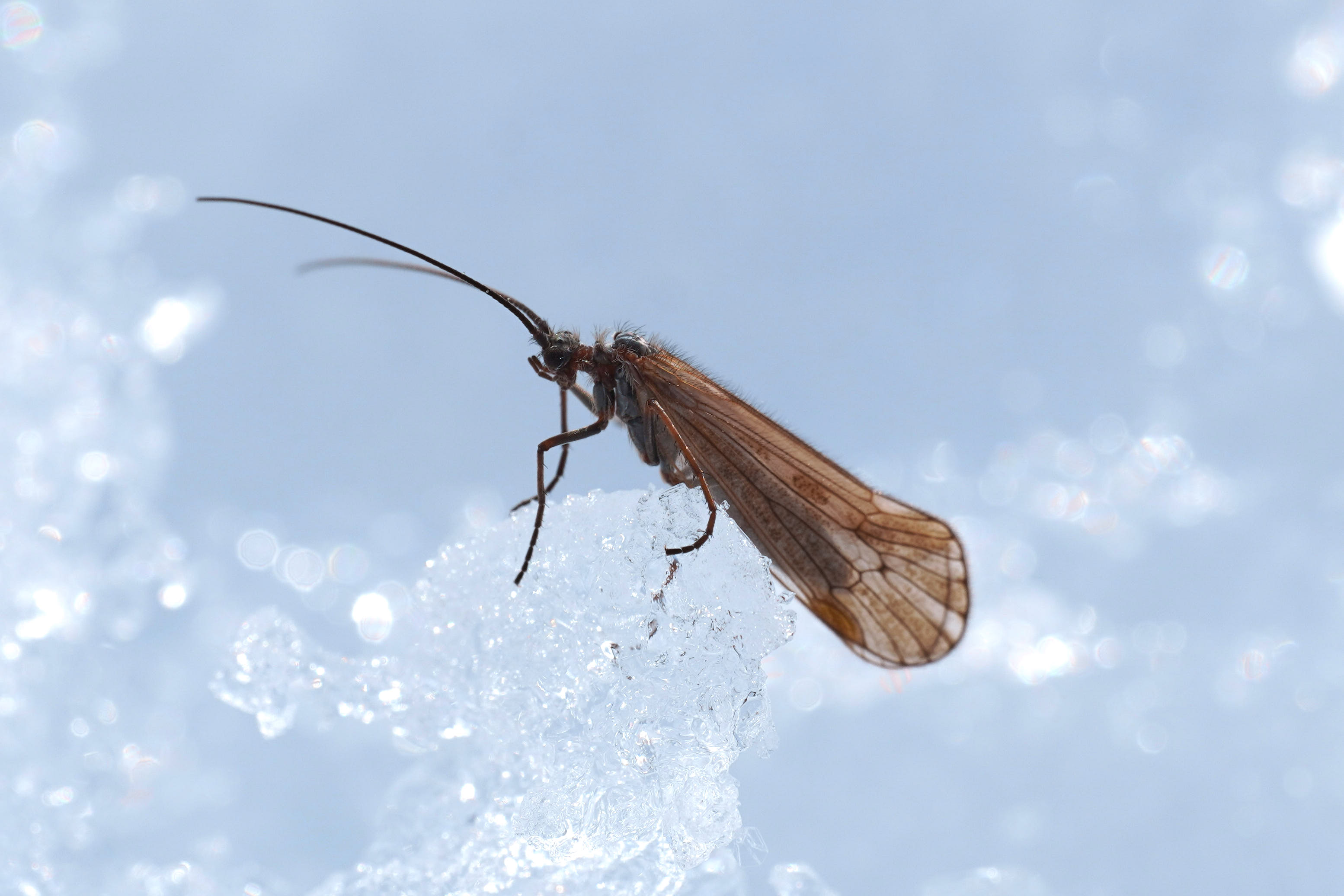
Image: Hankikorri (Taeniopteryx nebulosa), April 15, 2026, 9:15, Gilbbesjávri
Traveling to a place like Gilbbesjávri was for me a very special opportunity. With a certain level of focus on the work I was trying to responsibly maintain and the goals I had set for myself, I nevertheless found myself more absorbed by a feeling of excitement and adventure that already began on the way from Helsinki. After boarding the night train, nature documentaries in the spirit of David Attenborough started to run through my mind, the way I have always imagined such journeys.
This imagination filled me with enthusiasm in a way that made the trip feel far more adventurous than anyone might say it actually was. Twelve hours by train and six hours by bus is not a short journey. Yet I felt as if I were on a real expedition the entire time. In reality, the travel passed very quickly, partly thanks to the fact that I slept through the night train, and on the bus I was already attuning myself to the place, the land of the Sámi. While I am writing this text retrospectively, I am thinking back on whether my traveling by land would feel just as exciting a second time. Does this excitement actually come only from novelty? Yes and no. I think it very much depends on how much I allow myself to open my imagination and create new stories. How much I allow myself to be excited, and to what extent I search for the new within what is already familiar. It is perhaps also about planning, staying attentive, and cultivating this fascination alongside the direct consumption of new places.
An explosion of enthusiasm within me often creates a desire to record and document. From the moment I arrived at the Kilpisjärvi Biological Station, I was photographing and filming with fascination and pure joy anything that passed beneath my feet, flew above my head, stood in the distance, or appeared close to me. I tried to approach this visual research not as a form of recording or eager collecting, but as the creation of an action in the field.
On the first day, while walking across a frozen lake, I noticed a small, boldly moving being barely one centimeter in size. This species, called Hankikorri in Finland (Taeniopteryx nebulosa), is a type of insect I encountered during its mating period.(1) Individuals in this still cold period take advantage of the reduced presence of predators. The mating itself takes place in early spring, but for the individual it lasts only a few days. While males die after mating, females move toward the shore, where they feed on algae and lichens and gradually mature their eggs. At the beginning of summer, the female then lays eggs directly into the water while in flight. When other insects disappear with the arrival of autumn, Hankikorri awakens and begins to grow. In adulthood it emerges from beneath the ice in early spring. In Kilpisjärvi, where early spring only fully unfolds in May, I visited in late April, most likely arriving at the very beginning of their emergence onto the snow. This life cycle is the reason why they move so boldly across the snow. While I was observing their terrain as a frozen lake, an endless surface I could walk across, Hankikorri was dealing with lumps of frozen snow, ski and snowmobile tracks, and a drilled hole in the ice made by a fisherman was probably a nightmare for the insect. I watched for a while as it playfully struggled with these obstacles and then photographed it and said goodbye. Our encounter felt even more special because I did not see this species again in the following days around the station.
This act of recording through the camera lens was an action that equally affected the insect, myself, and the place of our encounter. From a fieldworking perspective, in such moments I also experience a performative layer in which the positions I find myself in due to macro photography create a moment of being-with the terrain. A terrain that was formed before my presence and will continue to change after my departure. This can also be understood as a kind of game, during which muscle memory develops a stronger relationship with the given place. I consider this understanding of the creative process as something dynamic, shifting in its making, as part of the terrain itself rather than a separate object.(2)
Through this perspective, I also try to approach photography during postproduction – not as a frozen moment, a representation of a place, or a product, but as an act that was part of a changing environment in which Hankikorri lives.
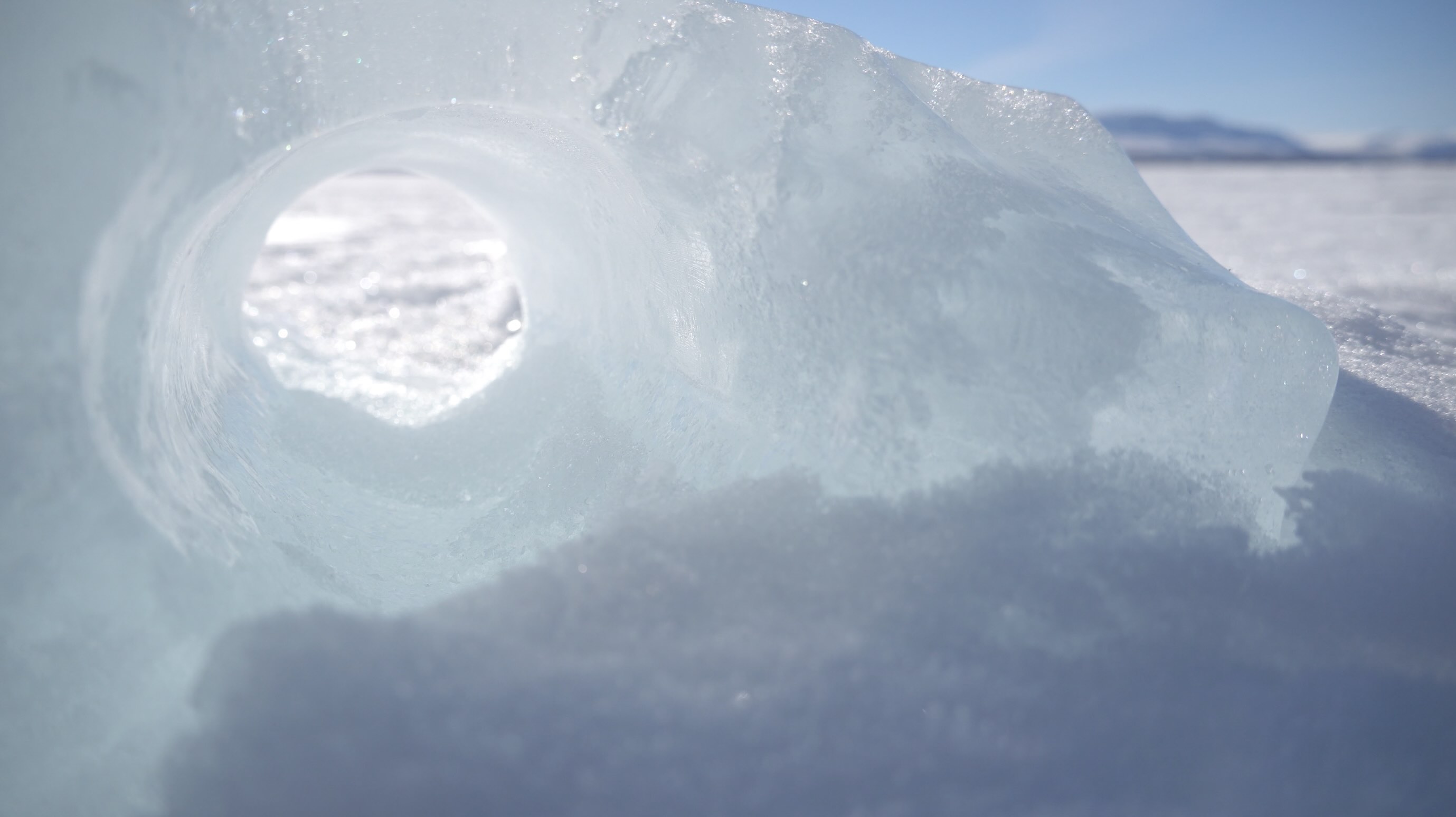
Image: video still, 3:22 min
I gradually applied the perspective that opened up to me through the encounter with Hankikorri in other days of fieldworking. One of the methods was the use of a low-position camera, capturing the surface of the frozen lake at the level of the snow cover, in an attempt to approach the perception of a being only one centimeter tall. Yet I also thought about insects from a completely different perspective – from above, during the ascent of Saana, a mountain rising above the station.
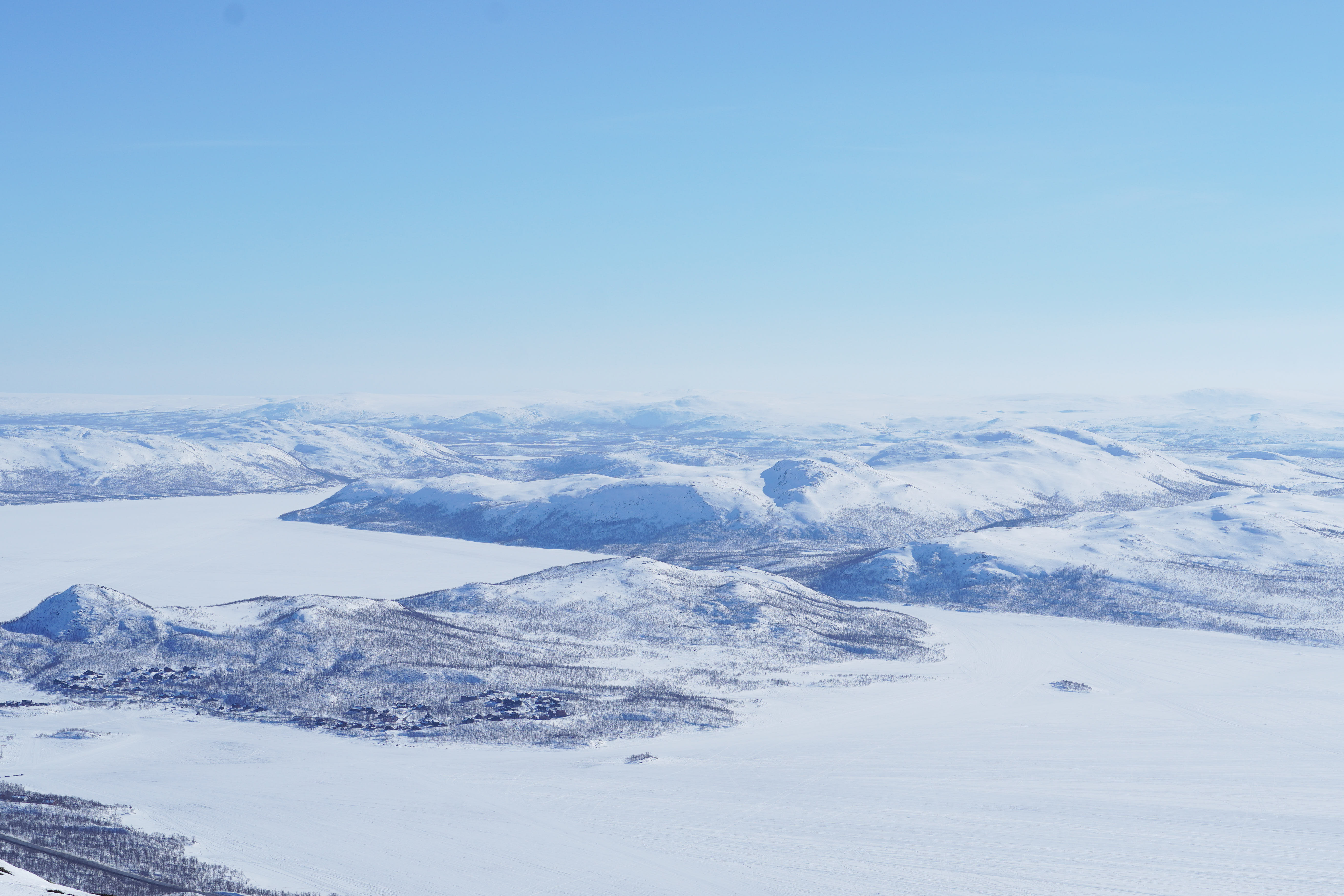
I went to Saana together with my partner Nela, with whom I shared many stimulating conversations during the hike. We asked ourselves the question: How are you? This question, however, was not directed towards each other, but at the surrounding environment in which we were visitors. From above I observed the frozen lake and asked: How are you? Who are you? Why are you? Who is overlapping you? Who is your neighbor? What’s going on with you? What kind of shapes and forms do you have?
We were not looking for answers to these questions. What mattered more was the awareness of the lake’s own being. That it is there. Despite focusing only on the lake, around me there were many more bodies unfolding – mountains, rocks, birds, trees, or insects. Some bodies are part of larger bodies, such as the eggs of Hankikorri, which live their lives within the body of the lake. All these bodies offer us a lot simply by being, by being observable, by being part of us, and by us being aware of them.
From Saana we observed the distant mountains. Mountains that, after our conversation, I no longer saw as belonging to Norway, Finland, and Sweden. This division has been a construct of the “nation state”, not of the beings that are, were, and will be the original inhabitants of these lands. Borders I previously knew from maps suddenly felt irrelevant. Insects, after all, also do not recognize these man-made borders. For Hankikorri, movement is not determined by states, but by terrain.
Before coming to Gilbbesjávri, I was encouraged to read up a bit on the locale and context, with particular consideration that this is the land of the Sámi. Through conversations with other researchers, it came as a surprise that they were unaware that they were researching on indigenous territory. This moment became crucial for me, as it opened a discussion about extractive research. A kind of research in which my previous way of thinking becomes its opposite: a place the visitor arrives in becomes consumed, without reciprocal action, without awareness of local context. This experience deepened my attention and my attempt to shift how I think about landscape in general. Even if it is difficult for my mind, shaped for decades within Western thinking, I like to imagine a landscape without borders and without words that narrow meaning. Instead, being aware of place as something that lives and exists in its own ways.
–
(1) www.vesi.fi(2) Sharp Kristen, Open Felds: Fieldwork as a Creative Process. In Crone Bridget, Nightingale Sam, Stanton Polly, Fieldwork For Future Ecologies. Eindhoven: Onomatopee Projects, 2024, p.52